THE GRAMMAR OF ATROCITY
GOYA, MANET, PICASSO AND THE ART OF PARAPHRASE
Text by Max
There are images that report. And there are images that remember.
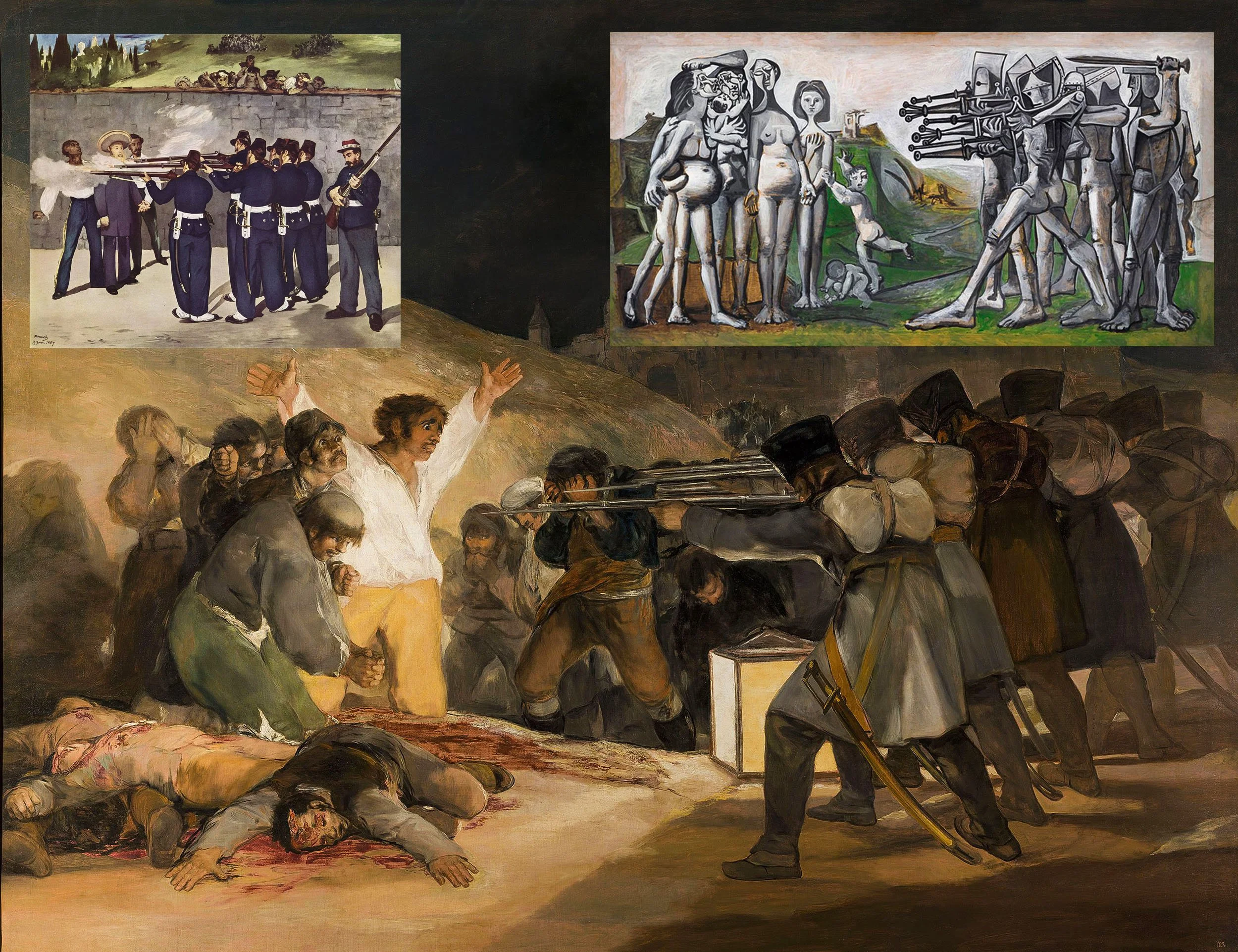
Across more than a century, three painters, Francisco Goya, Édouard Manet, and Pablo Picasso, returned to the same stark structure: a line of armed men facing defenceless bodies. The dates, places, and victims change. The visual grammar does not. It is as if art, confronted with organised killing, repeatedly reaches for the same sentence.
This is not “copying” in any simple sense. It is closer to a form of paraphrase: a deliberate re-use and re-contextualisation of a compositional argument, a visual sentence, revised to interrogate new historical realities and moral climates. Paraphrase, in this sense, is distinct from a literal copy, from playful pastiche, and from straightforward homage. It is a way of thinking with an older image, then rewriting it under new conditions.
In Goya, the execution becomes a scene of spiritual and ethical shock. In Manet, it turns cold, modern, and procedural. In Picasso, it hardens into allegory, with killers rendered almost as machines.
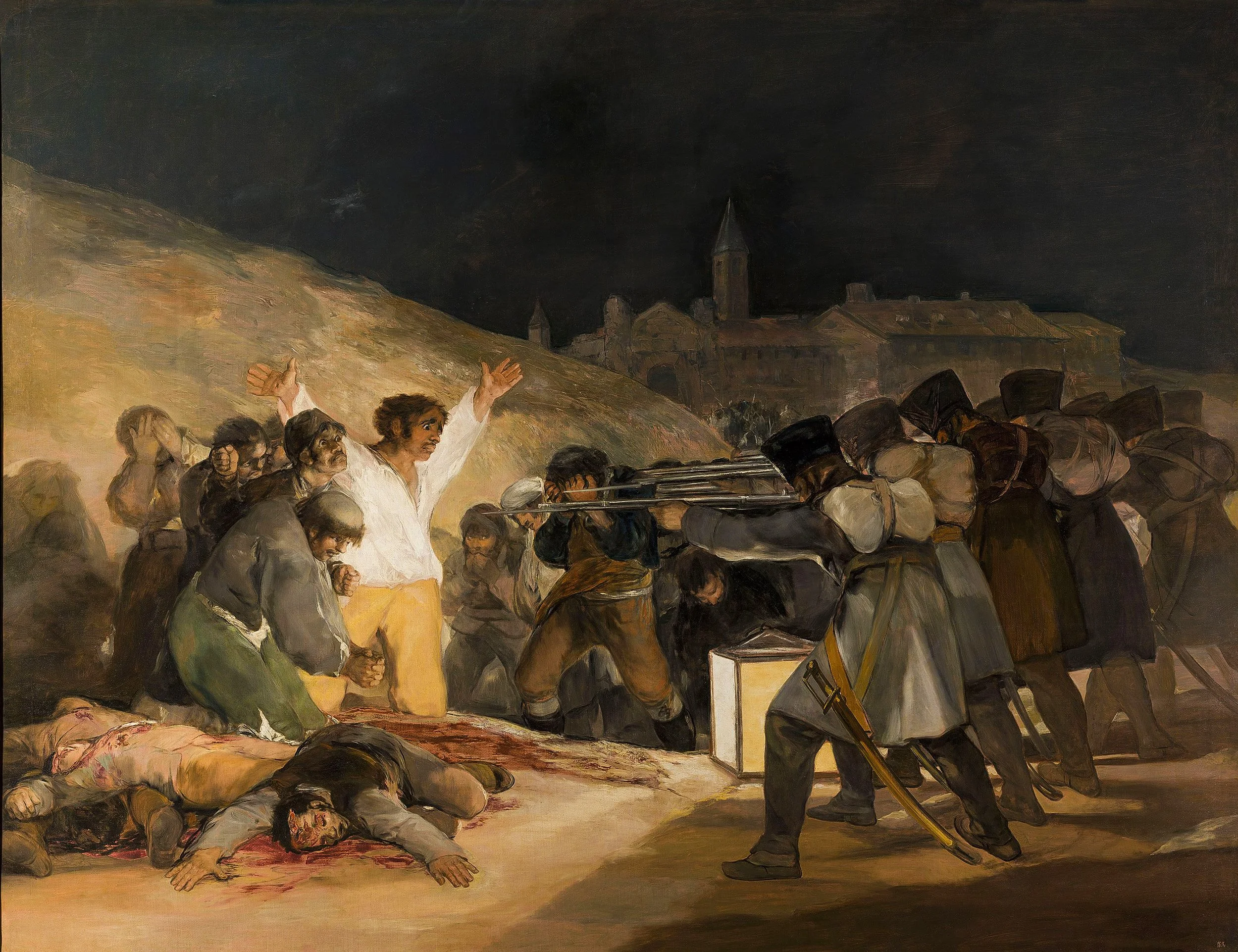
Francisco Goya, The Third of May 1808 (1814), oil on canvas, Museo Nacional del Prado, Madrid.
Painted after the expulsion of Napoleon’s forces, this uncompromising scene shows Spanish civilians executed by French soldiers during the Peninsular War. A lantern throws a harsh light onto the victims, isolating the central man in a white shirt with arms outstretched in a gesture that recalls a Christ figure, yet offers no redemption. The firing squad is shown as a faceless mechanism, a composition that became a lasting model for later artists, including Manet and Picasso, when they returned to the same visual grammar of state violence.
GOYA: A CHRIST FIGURE WITHOUT REDEMPTION
Goya’s The Third of May 1808 shows the execution of Spanish civilians by soldiers of Napoleon’s army during the Peninsular War. Painted in 1814, after the French had been driven out, it stands as a profoundly anti-heroic response to the brutality of occupation.
The scene is set at night, but it is not nocturnal in mood. It is lit like an interrogation. A lantern on the ground throws a harsh, unnatural glow upwards, exposing faces, hands, and fear. The soldiers, by contrast, are pushed into darkness and anonymity. Their backs turn towards us; their individuality dissolves into uniform and synchronised posture. The rifles form a rigid line, a mechanism aimed at flesh.
The victims are the opposite: distinct, various, human. Goya allows the eye to register different responses, panic, resignation, prayer, and disbelief, in a cluster of bodies that cannot be mistaken for a faceless mass. In the foreground lie corpses and blood, insisting that this is not a single moment but a process already under way. There is no narrative suspense, only the certainty of repetition.
At the centre stands the figure that makes the painting unforgettable: a man in a white shirt, arms thrown wide, body exposed. The gesture is unmistakable, and it carries the charge of Christian iconography. The outstretched arms recall the crucifixion; the white fabric, struck by light, reads as innocence made visible. The effect is not subtle, and it is not accidental. Goya uses the language of martyrdom to force a moral recognition: this is state violence, and it is killing the human in plain view.
Yet the painting refuses the consolations that Christian imagery often supplies. This is a Christ figure without redemption. There is no promise of meaning, no horizon of resurrection. The gesture that once implied salvation becomes, here, an accusation. The lantern does not illuminate grace; it illuminates the machinery of murder. Goya’s innovation is to make the execution scene function as an ethical confrontation: viewers are not invited to admire heroism or accept a political story. They are compelled to witness what power looks like when it stops pretending to be noble.
In this sense, Goya establishes a template that later artists can inherit: an execution not as an anecdote of war, but as an image of modernity itself, organised, impersonal, efficient, and irreversible.
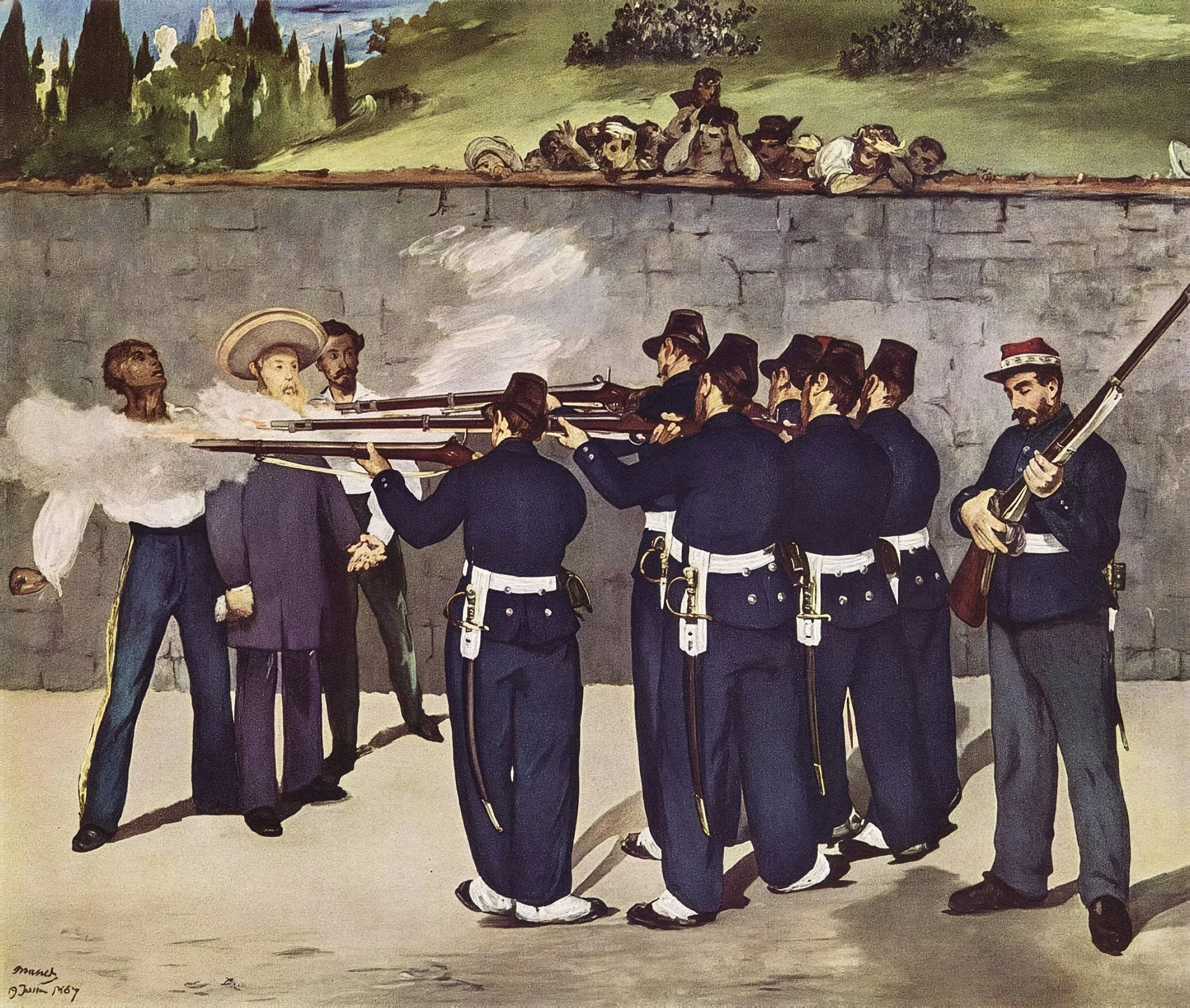
Édouard Manet, The Execution of Emperor Maximilian (1867–1869), oil on canvas, Kunsthalle Mannheim.
Manet presents the execution as a political fact rather than a moral drama. The firing squad operates with procedural detachment, and the absence of a Christ-like central figure removes any sense of redemption. Reworking the motif across multiple versions, Manet transforms Goya’s moral shock into a cool, modern image of state violence.
MANET: THE EXECUTION AS POLITICAL FACT
When Manet paints the execution of Maximilian, the structure looks familiar: victims on one side, firing squad on the other, rifles aimed across a shallow space. But the moral temperature changes dramatically.
Where Goya creates a spotlight of judgement, Manet drains the scene of theatrical illumination. Where Goya gives a focal figure whose posture summons a tradition of martyr imagery, Manet removes that possibility. There is no white-shirted centre, no sanctified body, no visual cue that instructs the viewer how to feel. The painting feels cooler, more distant, and, in that distance, more modern.
It also matters that Manet did not arrive at this image in a single, settled act. He reworked the motif across multiple versions of the scene, reshaping its structure and, in practice, colliding with the political sensitivities of his moment. The most complete version, now in Mannheim, presents the event not as Goya’s dramatic night piece, but with a chilling detachment.
Manet’s soldiers are still a collective, but they are not swallowed by darkness. They read as bodies in uniform rather than as a faceless force. The violence is not hidden. It is performed openly, as procedure. The rifles align with professional precision; the event has the emotional flatness of a state action carried out by trained hands. It is not an ambush in the night but an official outcome.
The victims, too, are treated differently. Maximilian is an emperor, not a civilian caught in an uprising. The drama is not innocence crushed by brute force, but politics collapsing into execution. Manet does not present Maximilian as a martyr whose death redeems anything. Instead, he appears trapped in the indifferent mechanics of history. The painting’s restraint feels like an ethical choice: it refuses the comforting clarity of a “good victim versus evil killers” tableau. It suggests that modern violence often arrives with paperwork, uniforms, and legitimacy.
If Goya’s key achievement is to make the victim’s humanity unbearable to ignore, Manet’s is to show how killing can look administratively normal, even when it remains morally grotesque. The scene is not elevated into tragedy. It is treated as political fact.
Manet’s painting becomes the bridge between Goya’s moral shock and Picasso’s broader accusation. In removing the Christ-like centre, Manet removes the last trace of redemptive framing. What remains is modernity’s cold face: violence administered rather than unleashed.
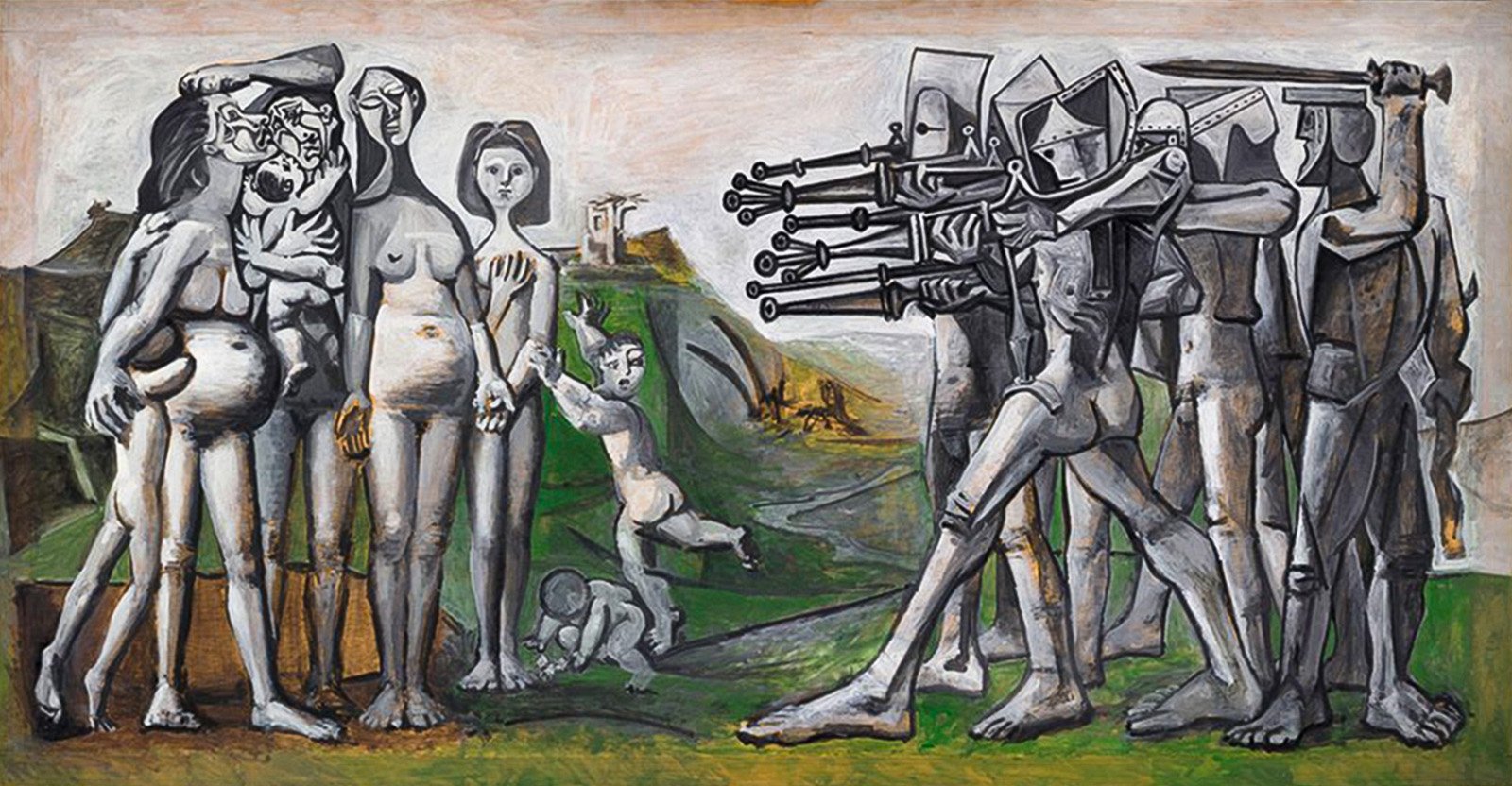
Pablo Picasso, Massacre in Korea (1951), oil on plywood, Musée Picasso, Paris.
Painted during the Korean War, Picasso’s work is not a documentary report but a deliberate, polemical image. The firing squad appears armoured and almost machine-made, turning the killers into a system rather than individuals, while the naked women and children register pure vulnerability. Echoing the compositional grammar of Goya and Manet, Picasso reshapes the motif into an allegory of mechanised violence in the modern age, broadly conceived.
PICASSO: THE KILLERS AS MACHINES, THE VICTIMS AS PURE VULNERABILITY
Picasso’s Massacre in Korea returns to the firing squad formula with almost schematic bluntness. Again, two groups face one another. Again, the weapon line aims at bodies. But Picasso intensifies the moral asymmetry: the victims are women and children, including a pregnant woman. Their nudity is not sensual; it is a brutal sign of exposure. They are stripped of status, protection, and even the minimal dignity of clothing. Picasso reduces them to what violence recognises least: the vulnerable human body.
Painted in 1951, during the Cold War and amid the Korean War, Massacre in Korea is not a documentary record of a single incident. It is a deliberate, polemical work that uses the firing squad grammar to condemn the mechanised violence of modern warfare and political oppression, broadly conceived.
Opposite the victims stand the killers. They look robotic: armoured, angular, rigid, as if assembled rather than born. This matters. Picasso is not merely stylising for effect. The robot-like form turns the firing squad into a visual argument about how mass killing becomes thinkable.
A human executioner might invite psychological questions: fear, hatred, obedience, remorse. Picasso refuses that route. By making the soldiers appear almost machine-made, he suggests a deeper horror: violence that has passed beyond individual emotion into system. The killers become instruments, not personalities. Their bodies read as armour and mechanism; their interiority is irrelevant. In this sense, Picasso pushes Goya’s anonymity to an extreme. Where Goya hides faces in darkness, Picasso redesigns the killers as near non-human entities. The ethical point is sharpened: organised violence functions by reducing persons to roles, and finally to tools.
There is also a temporal collision in the soldiers’ appearance. Their armour can evoke older forms of militarised authority, while their weapons speak the language of modern war. The effect is to suggest continuity: the technology changes, but the structure of massacre persists. In this way, Picasso composes a vision of the massacre form itself, a pattern that repeats across centuries.
Picasso, like Goya, is Spanish, and the kinship is real. Both artists understand that the firing squad scene is not merely a story about death. It is a story about power’s relationship to the human body. But where Goya draws on Christian iconography to intensify recognition, Picasso strips that language away and replaces it with the imagery of the machine. The victims do not look like saints; they look like exposed life. The killers do not look like men; they look like the system that turns killing into routine.
A SHARED GRAMMAR, REWRITTEN FOR NEW REALITIES
Seen together, the three works form a lineage of paraphrase. Goya establishes a grammar of execution as moral shock, centred on a figure that recalls Christ yet offers no redemption. Manet retains the structure but removes the sacred centre, presenting killing as political fact, carried out with procedural calm. Picasso inherits the same arrangement and pushes it into a broader condemnation: victims become pure vulnerability, and killers become almost robotic, the image of violence as system.
This is why the compositional similarities matter. Their repetition is not coincidental. It signals that certain forms of violence demand certain forms of seeing. Art returns to the firing squad composition because it stages the most brutal asymmetry imaginable: weapons against bodies, organisation against exposure, power against the human.
Paraphrase, in this context, is not imitation. It is memory. The image persists because it keeps asking the same question, in different centuries and different wars:
How does a society make killing look normal, and what does it take for an image to make it intolerable?