JULIAN THE APOSTATE
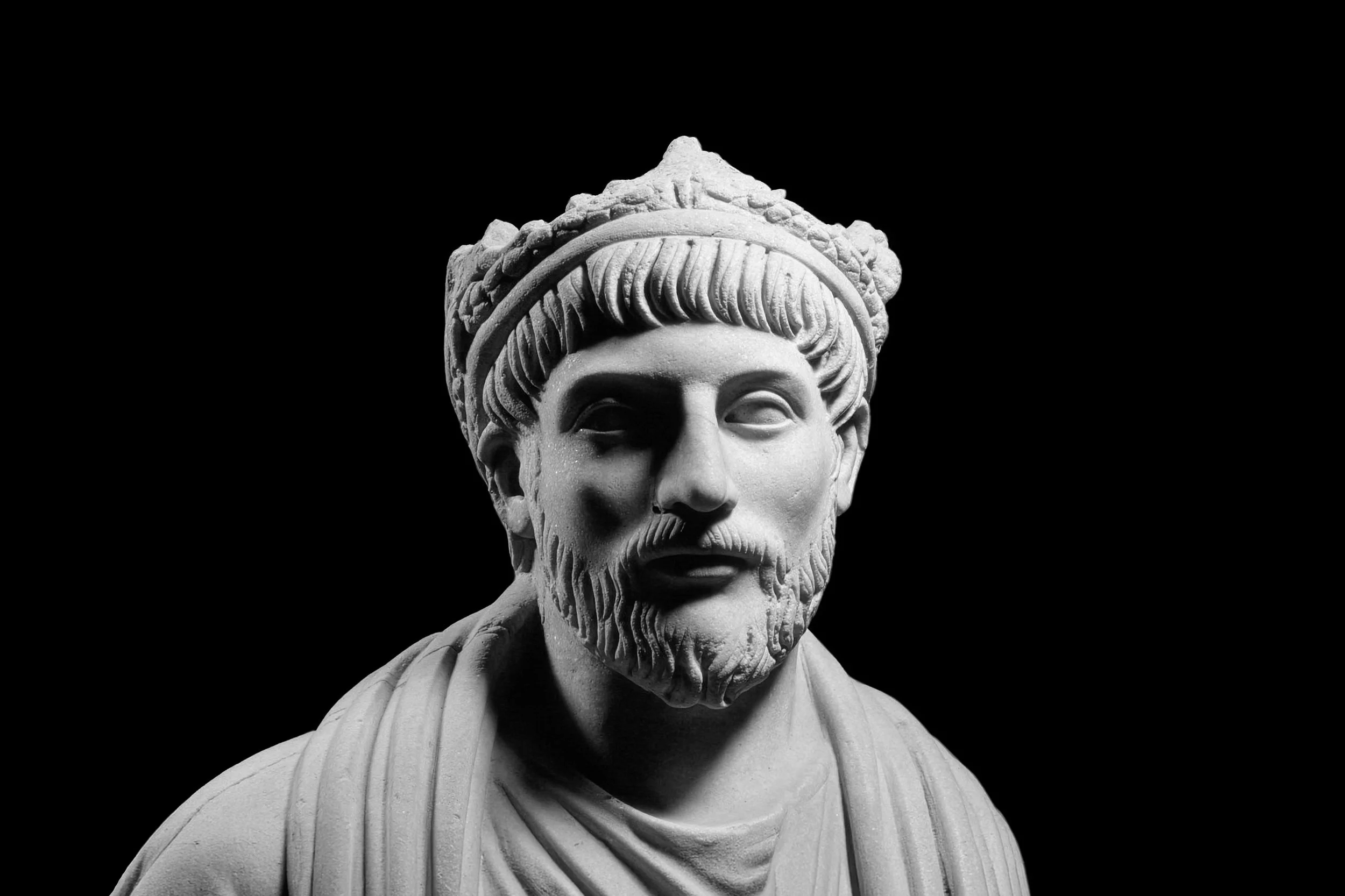
Marble statue long identified as Julian the Apostate, but now often interpreted as a priest of Sarapis. The uncertainty is fitting: even Julian’s image, like his memory, remains contested.
THE ROMAN EMPEROR WHO TRIED TO REVERSE HISTORY
Text by Max
The spear entered below the ribs.
Dust hung over the broken ground. Men shouted in Greek and Latin. Horses turned in panic. Somewhere in the confusion of the Roman retreat from Persia, the emperor had been struck.
Julian the Apostate did not fall into legend at once. He was carried to his tent, still conscious, bleeding heavily. Ancient accounts describe him speaking calmly through the night with companions and philosophers, discussing the soul and fate while surgeons tried to save him. By dawn in June 363 CE, he was dead.
He was thirty-one or thirty-two years old.
No Roman emperor had attempted what Julian had attempted. Raised in a dynasty that had embraced Christianity, he turned instead to the old gods, Greek philosophy and the cultural prestige of the classical world. As ruler, he tried to slow, redirect and perhaps reverse the Christianisation of the Roman Empire.
He failed.
But failure can matter as much as victory. Julian’s reign as sole emperor lasted less than two years, yet it remains one of the clearest moments in Roman history when the future still seemed undecided.
THE BOY WHO SURVIVED
Julian was born into power and into danger.
He was a nephew of Constantine the Great, whose reign transformed the empire and gave Christianity imperial favour. But dynasties rarely produced security. After Constantine’s death in 337, members of the imperial family were killed in a bloody purge. Julian’s father was among them.
Julian survived. So did his half-brother Gallus.
Much of Julian’s youth was then spent under supervision at Macellum in Cappadocia, a former royal estate that became a gilded confinement. He later described those years as a kind of captivity: imperial blood, tutors, guards and Homer - birth experienced as sentence as much as privilege.
That shaped everything that followed. Julian was not raised as a confident heir. He was raised as a vulnerable relative who had learned early that court politics could kill.
He received a Christian education, yet his imagination moved elsewhere: the Iliad, Plato, rhetoric, memory, Greek style, heroic models. Books became a refuge before power became a possibility.
His tutor Mardonius introduced him to classical literature. Later he came under the influence of intellectual figures such as Libanius and Maximus of Ephesus.
Alexander had Aristotle. Julian had the late antique world of rhetoricians, philosophers and religious teachers.
THE MAN WHO DEFENDED A WORLD ALREADY CHANGED
Julian often presented himself as a restorer of ancient religion against Christian novelty. The reality was more complicated.
The paganism of the fourth century was not simply the religion of classical Athens or republican Rome preserved intact. It had absorbed centuries of change: Platonist metaphysics, symbolic readings of myth, solar theology, ritual theory and the mystical practices known as theurgy, attempts to approach the divine through sacred rites.
Julian believed he was returning to old wisdom. In practice, he was also defending a distinctly late antique reconstruction of it.
That does not diminish him. It makes him more interesting.
He was not the guardian of a frozen past. He was a creative traditionalist trying to build an alternative future.
THE SCHOLAR WHO COULD COMMAND
In 355, Emperor Constantius II appointed Julian Caesar and sent him to Gaul.
The appointment looked risky. Julian was young, politically exposed and better known for study than war. Yet in the western provinces he surprised almost everyone.
At Strasbourg in 357, Roman discipline held under severe pressure and Julian’s forces defeated the Germanic coalition. Soldiers who expected a palace intellectual found a commander willing to share hardship and remain visible in danger.
This combination became central to his reputation: a cultivated Greek mind inside a disciplined Roman war leader.
Later admirers polished the image. We should be cautious. Julian knew how to stage himself. Yet even sceptics must admit that he possessed unusual courage, stamina and force of will.
THE THRONE AND THE OLD GODS
In 360, Julian was proclaimed Augustus by troops in Paris. Civil war with Constantius II seemed possible, but Constantius died in 361 before the conflict could be settled. Julian became sole ruler of the empire.
Then he declared what many suspected: he had abandoned Christianity.
Later Christian writers fixed on the title “the Apostate”, the man who had deserted the faith. The label survived because it was memorable and politically useful.
Julian himself would have rejected it completely. He did not think he had betrayed truth. He thought he had returned to it.
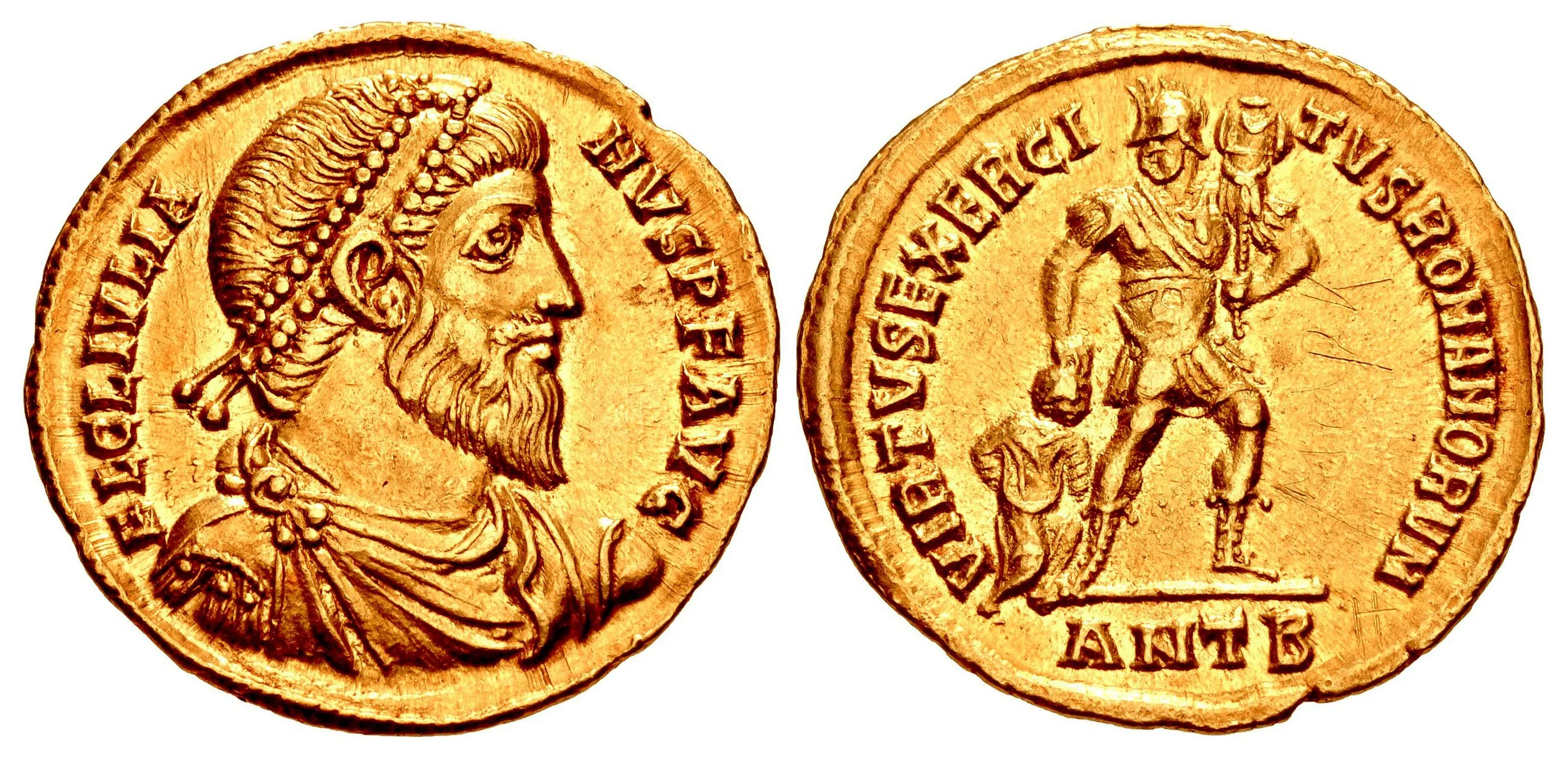
Gold solidus of Emperor Julian, struck at Antioch, AD 361-363. The obverse bears the imperial portrait. The reverse invokes the virtus exercitus Romanorum: a soldier advancing with trophy and captive, Roman power struck in gold.
WHAT JULIAN ACTUALLY DID
Popular accounts often distort Julian in opposite directions.
Some portray him as a tolerant philosopher unfairly slandered by Christians. Others present him as a pagan persecutor waiting to revive the old terror.
Neither picture is sufficient.
Julian did not launch an empire-wide blood persecution. But nor was he neutral. He used law, patronage, prestige and exclusion to weaken Christianity and strengthen rival traditions.
Temples were restored. Sacrifice returned to imperial favour. Bishops lost influence at court. Exiled churchmen were recalled in some cases, partly because Julian understood that divided Christians could fight one another more effectively than united ones.
His most revealing measure came in 362: the school edict.
Christian teachers, Julian argued, should not teach Homer, Hesiod and the classical canon while rejecting the gods honoured in those works. The decree targeted access to elite education - paideia, the literary training that helped reproduce Roman governing culture.
No executions were required.
If Christians could be pushed away from the educational ladder, their future influence might narrow over time.
It was a brilliant, coercive and elitist move.
Even Ammianus Marcellinus, often sympathetic to Julian, considered it harsh.
JULIAN IN HIS OWN WORDS
Unlike many emperors, Julian wrote extensively.
He wrote letters, speeches, satire and religious polemic. Through those texts we encounter not only policy, but temperament.
In one letter he urged priests to live seriously, practise charity and behave with dignity, because he understood that religion survived through institutions as much as beliefs.
Elsewhere he mocked Christians as “Galilaeans”, reducing a universal faith to a provincial movement from Galilee. It was a rhetorical demotion.
ANTIOCH AND THE MAN WHO WANTED TO BE LOVED
Antioch was one of the great cities of the eastern empire: crowded streets, racing factions, merchants, sharp tongues, public entertainments, religious variety and political nerves.
Julian arrived hoping for seriousness and renewal. Instead he found resistance.
Citizens mocked his beard, his austerity, his attempts to regulate prices and his moralising tone. He found them frivolous. They found him strange.
His response was Misopogon, part satire, part complaint, part self-defence. There he offered a line that captures both vanity and wounded pride:
I let my beard grow long to give the lice something to live on.
The joke lands because it is half true. Julian could laugh at himself. He could also never forget that others were laughing first.
Read politically, the text records failure. Read psychologically, it reveals something deeper: Julian did not merely want obedience.
He wanted to be admired by the world he believed he was rescuing.
HIS GREATEST ENEMY WAS TIME
Gregory of Nazianzus would later attack Julian brilliantly in print, helping shape the hostile memory that endured for centuries.
But Gregory was not Julian’s greatest enemy.
Time was.
By the 360s, Christianity was no longer just an imperial fashion. It had congregations, bishops, donors, widows, property and local roots across the empire. In many cities, bishops mediated disputes, wealthy patrons endowed churches, and Christian communities offered burial, charity and belonging. It was internally divided - Arian and Nicene conflicts were bitter - but it was socially embedded.
Julian seems to have believed that imperial energy and cultural prestige could still reverse the movement.
That was his boldness.
It may also have been his illusion.
THE SHADOW OF ALEXANDER
In 363, Julian marched east against Persia.
No name haunted that road more than Alexander the Great. Alexander had crossed into Asia and become legend. Any emperor marching east entered that shadow.
Did Julian imagine himself a new Alexander? Probably not in any childish sense. But glory, victory and historical stature clearly mattered to him. A triumphant Persian campaign would have transformed his reign.
Instead, the expedition became a trap.
Roman forces advanced boldly, then moved too deep into hostile territory. At some stage of the campaign, much of the fleet was destroyed or abandoned, reducing mobility and supplies under circumstances the sources describe imperfectly. Persian forces avoided the decisive battle Rome wanted, harried the Roman column, scorched the land and let distance, heat and hunger do their work.
The retreat became a running crisis.
Then came the spear.
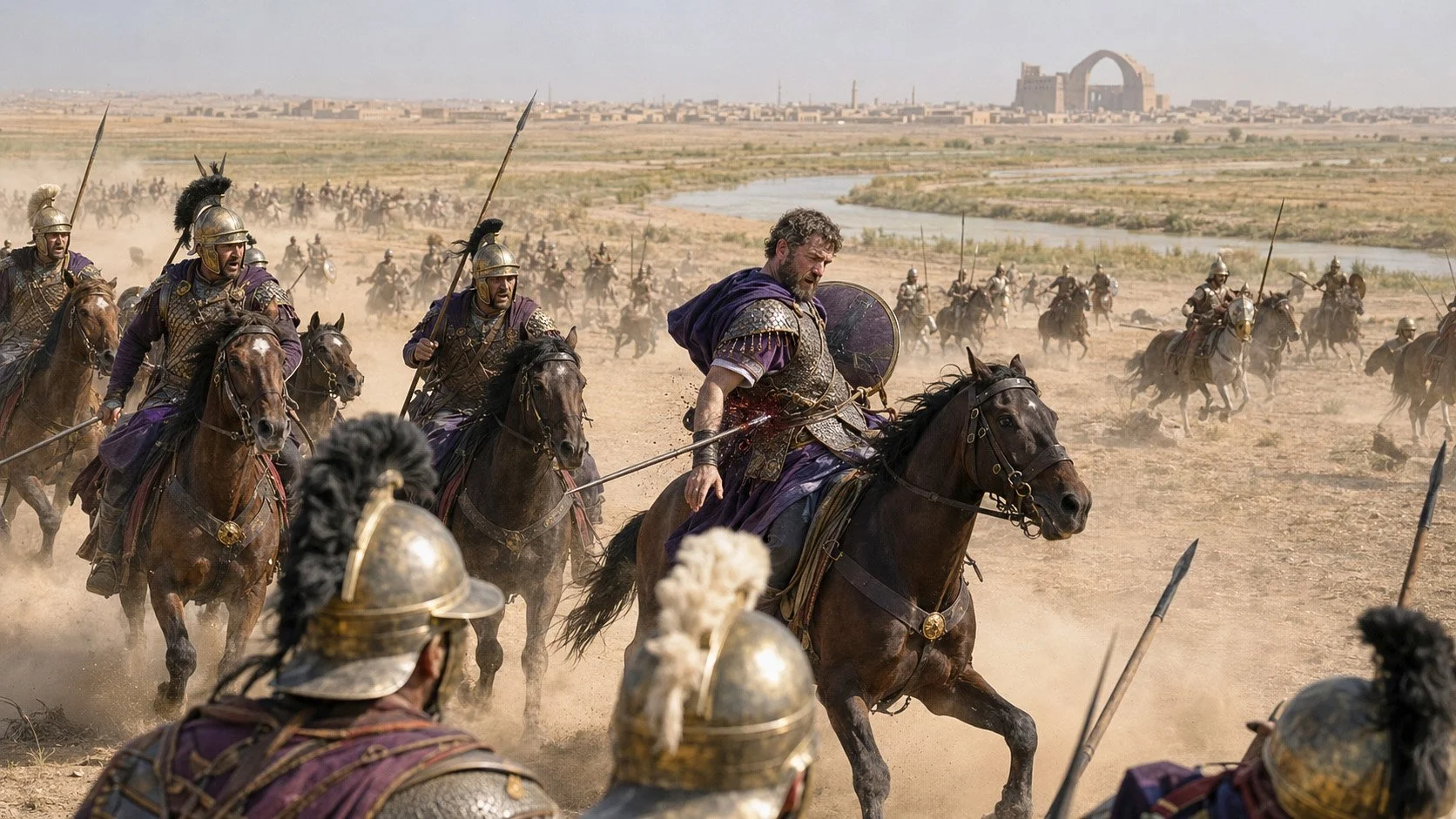
AI-generated historical visualisation of Emperor Julian being mortally wounded during the Roman retreat from Ctesiphon, near Samarra, AD 363. The source tradition does not securely identify who threw the spear, and the image should be read as an imaginative reconstruction rather than a documentary depiction.
WHO KILLED JULIAN?
This question should be handled carefully.
The most probable answer is straightforward: Julian was struck in combat by an enemy weapon during a confused engagement in the retreat.
That remains the strongest historical judgement.
Yet rumours began almost immediately. Some later accounts suggested that a Roman Christian soldier had thrown the fatal spear. These claims are weak as evidence and powerful as symbolism.
That distinction matters.
The rumour tells us less about the battlefield than about the empire Julian ruled.
If a Persian killed him, Julian was a fallen commander.
If a Roman Christian killed him, he was betrayed by the empire he tried to save.
If God killed him, as hostile writers implied, then history itself had judged him.
The mystery lies less in the weapon than in the stories told about it.
HOW TO READ THE SOURCES
Our best narrative source for Julian’s final campaign is Ammianus Marcellinus. He is indispensable.
He is also not neutral.
Ammianus admired Julian’s discipline, military seriousness and personal courage. His Julian is often noble, energetic and tragically flawed. That portrait may contain truth. It is still a portrait.
Libanius, one of Julian’s pagan admirers, is equally valuable and equally partial. His grief and admiration preserve how Julian’s supporters wished him remembered.
Christian writers had opposite incentives. Gregory of Nazianzus and others wanted Julian remembered as arrogant, impious and doomed.
The historian’s task is not to choose one myth over another, but to read motives as carefully as facts.
WHY JULIAN STILL MATTERS
Julian was unlikely to erase Christianity from the empire. Too much had already changed below the level of imperial decree. How far he might have redirected events remains debated by historians.
But he might have altered tempo, prestige and political balance. He might have prolonged a more openly contested religious future.
Julian fascinates because he stood at one of history’s narrowing doorways.
He was intelligent enough to see that a world was ending, powerful enough to try to stop it, gifted enough to make the attempt serious, and limited enough to fail.
He was not the hero of pagan nostalgia. He was not the monster of Christian legend.
He was a brilliant, self-dramatising, wounded Roman emperor who saw the future forming around him and tried to turn it aside.
FURTHER READING
Glen Bowersock, Julian the Apostate - a clear and influential modern overview.
Rowland Smith, Julian’s Gods - essential on Julian’s religious thought.
Shaun Tougher, Julian the Apostate - a modern reassessment of the emperor and his reign.
Polymnia Athanassiadi, Julian and Hellenism - valuable on philosophy and ideology.
H.C. Teitler, The Last Pagan Emperor - concise and sharp on Julian’s politics and reputation.