THE FED DID NOT MOVE. MARKETS DID
THE FED DID NOT MOVE. MARKETS DID
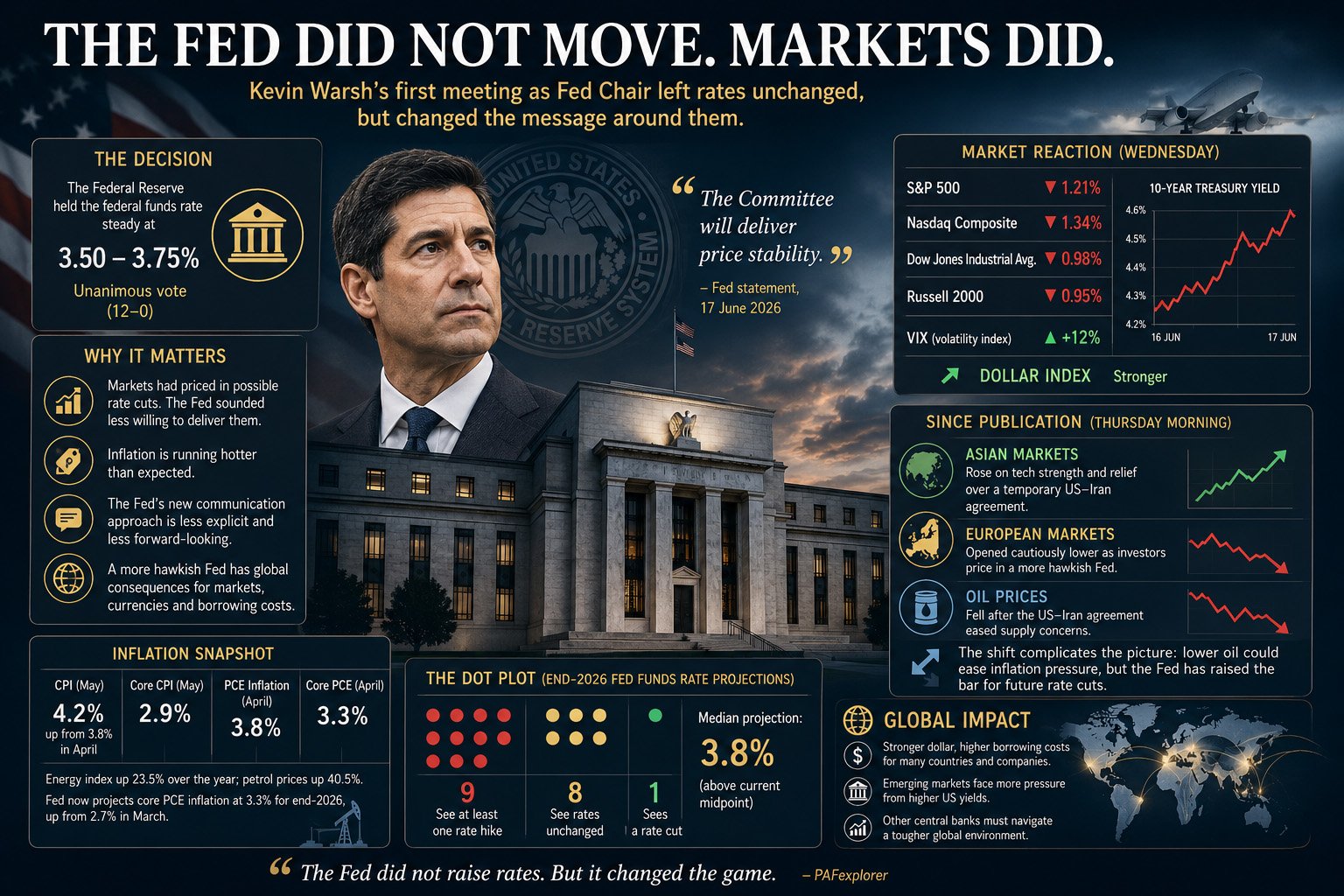
Kevin Warsh’s first meeting as Federal Reserve Chair left interest rates unchanged, but changed the message around them. Cuts are no longer the obvious next step.
18 June 2026
Text by Max
Disclaimer: This article is an independent analytical assessment provided for informational purposes. It does not constitute personalised investment advice or a recommendation to buy, hold or sell any security.
The Federal Reserve left interest rates unchanged on Wednesday. That was expected. What was not expected was how firmly America’s central bank shifted the conversation away from rate cuts and back towards inflation.
The Federal Open Market Committee kept its benchmark federal funds rate in a range of 3.50 to 3.75 per cent. The vote was unanimous, with all 12 voting members supporting the decision. There was no emergency move, no dramatic increase and no visible split at the table.
Yet the market reaction was sharp. By the close in New York, the S&P 500 had fallen 1.21 per cent, the Nasdaq Composite was down 1.34 per cent, and the Dow Jones Industrial Average had lost 0.98 per cent. The Russell 2000, an index of smaller American companies, also slipped. The VIX, Wall Street’s most closely watched measure of expected volatility, rose by more than 12 per cent. Treasury yields climbed, and the dollar strengthened.
Markets had prepared for the Fed to hold rates steady. They had not prepared for a central bank that sounded less willing to guide investors towards easier money.
For much of the year, the question hanging over Wall Street had been when the Fed would begin cutting rates. After Wednesday, the more uncomfortable question is whether the next move could instead be a hike.
That is why Kevin Warsh’s first meeting as Federal Reserve Chair matters. The rate decision itself was static. The signal around it was not.
By Thursday morning in Europe, the picture had become more mixed. Asian markets rose, helped by technology shares and relief over a temporary US-Iran agreement that pushed oil prices lower. European shares opened slightly weaker, however, as investors continued to price in a more hawkish Fed. The shift did not overturn Wednesday’s message; it complicated it. Lower oil prices may ease some inflation pressure, but Warsh’s Fed has still changed the burden of proof for future rate cuts.
A PAUSE WITH HARDER EDGES
Warsh took office as Fed Chair on 22 May 2026. Less than a month later, he faced a problem that would test any central banker: the economy is still growing, the labour market has not cracked, and inflation has moved in the wrong direction.
The Fed’s new statement was short and unusually direct. It described economic activity as expanding at a solid pace, despite elevated uncertainty linked in part to the conflict in the Middle East. It noted strong productivity growth and capital investment, steady job gains and little change in unemployment.
Then came the sentence that framed the meeting: “The Committee will deliver price stability.”
That line matters because central banks influence markets not only by changing interest rates, but by changing expectations. When the Fed signals that lower rates are coming, investors tend to become more willing to buy shares, borrow money and take risk. When it sounds more worried about inflation, the opposite happens. Borrowing may stay expensive for longer. Companies may become more cautious. Households may wait longer for relief on mortgages, car loans and credit-card debt.
Wednesday’s statement did not promise higher rates. It did something subtler. It removed much of the comfort markets had heard in earlier statements, where the language still pointed towards the possibility of future cuts.
The result was a pause that felt less like patience and more like warning.
WARSH CHANGES THE FED’S VOICE
One of the most important parts of Wednesday’s meeting was not the rate decision, but the style of communication.
Warsh described the new statement as “a bit shorter, a bit simpler”. He also said it removed older language and dispensed with what central bankers call forward guidance.
Forward guidance is the Fed’s practice of signalling in advance where policy is likely to go next. After the global financial crisis, it became a major tool of central banking. When interest rates were near zero, central banks could still influence markets by promising, hinting or warning about the future.
Warsh appears less convinced that this approach fits the present moment. His message was that markets should pay more attention to the economy itself, and less to every carefully polished phrase from the Fed. Inflation, jobs, wages, growth, energy prices and credit conditions should matter more than decoding central-bank signals.
That approach has a certain intellectual clarity. It may also make markets more volatile. Investors dislike uncertainty, and when the Fed gives them less guidance, they often demand a higher reward for taking risk. That can push share prices lower, bond yields higher and the dollar upward.
Reuters noted that the shorter statement marked a return to a format closer to the Greenspan era, when the Fed often said less and let markets infer more. That historical comparison is useful, not because Warsh is simply copying Alan Greenspan, but because it shows how far the Fed may be moving away from the more explanatory style associated with Jerome Powell.
The danger is that less guidance becomes less clarity. The potential benefit is that the Fed may become less trapped by its own previous wording.
THE DOT PLOT TURNS COLDER
The strongest policy signal came from the Fed’s projections.
Every quarter, Fed officials publish forecasts known as the Summary of Economic Projections. The best-known part is the dot plot. Each dot represents one policymaker’s view of where interest rates should be at the end of a given year.
The dots are anonymous. They are not promises. They are not an official timetable. But investors watch them closely because they show how opinion inside the Fed is moving.
This time, the movement was clear. Eighteen Fed participants submitted projections. Nine expected at least one rate increase before the end of 2026. Eight expected rates to remain unchanged. Only one saw a rate cut.
That is a decisive change from the story markets preferred. In March, the median Fed projection still pointed towards a rate cut in 2026. By June, the median projection pointed to the federal funds rate ending the year at 3.8 per cent, above the midpoint of the current range.
In plain language, the Fed’s centre of gravity has moved from “cuts may be coming” to “rates may need to go higher”. That does not make a rate hike inevitable. Projections can change quickly if energy prices fall, inflation cools or the economy weakens. But financial markets do not wait for certainty. They adjust as soon as the balance of risk changes.
On Wednesday, that balance moved in a more hawkish direction.
WARSH’S MISSING DOT
Warsh did not submit a dot of his own.
This may sound like a technical detail, but it matters. A Fed Chair’s projection can easily become the most important dot on the chart, even when the dots are meant to be anonymous. If Warsh had submitted one, markets would have tried to identify it and treat it as a personal signal from the Chair.
By withholding his own projection, Warsh avoided giving investors a single point to anchor on. He also underlined a broader view: the future path of interest rates should not be presented as if it can be drawn neatly in advance.
It is a defensible position, because economic forecasts often look more precise than they really are. They come in numbers and charts, while the real economy remains messier. Oil prices can jump. Wars can shift supply chains. Consumers can surprise. Labour markets can turn slowly and then suddenly. Data can be revised.
The risk is that investors, businesses and households still need some sense of how the central bank thinks. A Fed that avoids false precision may gain flexibility. A Fed that becomes too difficult to read may lose some of the trust that clear communication is meant to protect.
Warsh’s first meeting suggests that he is willing to test that boundary.
INFLATION IS STILL THE PROBLEM
The tougher tone is rooted in a simple fact: inflation has become harder to dismiss.
The consumer price index rose 4.2 per cent over the year to May, up from 3.8 per cent in April. Core CPI, which excludes food and energy because those prices can swing sharply from month to month, rose 2.9 per cent.
Energy is the most visible pressure point. The energy index was up 23.5 per cent over the year, while petrol prices rose 40.5 per cent. That matters far beyond petrol stations. Higher fuel costs feed into transport, food, travel, manufacturing and household budgets. Even when some prices remain stable, expensive energy can make daily life feel noticeably harder.
The Fed’s preferred inflation measure, the personal consumption expenditures price index, also remains too high. In April, headline PCE inflation stood at 3.8 per cent from a year earlier, while core PCE was 3.3 per cent.
The Fed’s own projections now reflect a much more uncomfortable inflation picture. Policymakers expect PCE inflation to end 2026 at 3.6 per cent, up from 2.7 per cent in their March forecast. Core PCE inflation is projected at 3.3 per cent, also up from 2.7 per cent.
These numbers alter the policy debate. A Fed expecting inflation close to 2 per cent can prepare the ground for cuts. A Fed expecting inflation above 3 per cent has to defend its credibility before it can offer relief.
WHAT THE FED CAN AND CANNOT CONTROL
The Fed cannot pump oil, reopen shipping routes or end conflict in the Middle East. If inflation rises because energy prices jump after a geopolitical shock, the central bank cannot solve the original cause.
What it can do is try to stop that shock from spreading through the rest of the economy.
That is the distinction at the heart of Wednesday’s decision. A temporary rise in oil prices is painful. A broader inflation cycle is more dangerous. If companies raise prices because they expect their costs to keep rising, and workers demand higher wages because they expect life to become more expensive, inflation can become embedded. Once that happens, bringing it down usually requires more economic pain.
This is why the Fed may sound hawkish even when part of the inflation problem comes from forces outside its control. It is not trying to set the price of every barrel of oil or carton of eggs. It is trying to stop temporary shocks from becoming permanent inflation.
That is the narrow path Warsh has inherited.
WHY STOCKS FELL WHEN RATES DID NOT RISE
For many readers, the market reaction may seem strange. If rates stayed the same, why did stocks fall?
The answer is that markets react to expectations as much as to decisions. Investors care not only about where interest rates are today, but where they may be in six months, a year or two years. When that expected path changes, asset prices can move immediately.
Higher rates hurt shares in several ways. They make borrowing more expensive, so companies that rely on loans to expand, invest or refinance debt face higher costs. They can also reduce household spending, because mortgages, car loans and credit-card debt stay costly.
Higher rates also make safer assets more attractive. If investors can get a reasonable return from cash or short-term government bonds, they may be less willing to take the extra risk of owning shares.
The effect can be especially strong for companies whose value depends heavily on profits expected far in the future. Many technology and AI-related companies fall into this category. Investors are willing to pay high prices for future growth when money is cheap. When rates rise, those distant profits look less valuable in today’s money.
The Fed did not tighten policy by raising rates. It made investors rethink the future path of policy, and that was enough to push stocks lower.
BONDS AND THE DOLLAR CONFIRMED THE MESSAGE
The bond market sent the same signal.
The two-year Treasury yield, which is especially sensitive to expectations for Fed policy, rose sharply. The ten-year yield, which influences mortgages and many other long-term borrowing costs, also moved higher.
Bond yields move in the opposite direction to bond prices. When investors sell bonds, yields rise. After a Fed meeting, rising yields usually mean markets expect tighter policy than before.
The dollar strengthened for a similar reason. Higher US yields make dollar assets more attractive to global investors. To buy those assets, investors usually need dollars, and that extra demand can lift the currency.
A stronger dollar can help American consumers by making imports cheaper. Abroad, the picture is more difficult. Countries and companies that have borrowed in dollars must repay those debts in a currency that has become more expensive. For them, a stronger dollar can make old debts feel heavier.
This is one reason the Fed matters globally. Its decisions do not stop at the edge of the United States. They affect currencies, commodities, emerging markets, global trade and other central banks.
TRUMP WANTED EASIER MONEY. WARSH DID NOT DELIVER IT.
There is also a political story.
Warsh was appointed by President Donald Trump after a period in which Trump repeatedly called for lower interest rates. For anyone expecting Trump’s new Fed Chair to deliver easier money quickly, Wednesday was a disappointment.
The meeting produced no cut. It produced a unanimous hold, a sharper inflation message and projections showing that many policymakers now see a possible hike before the end of the year.
No central bank operates outside politics. Interest rates affect mortgages, jobs, investment, government borrowing costs and presidential approval ratings. But Wednesday sent a clear institutional signal: inflation, not political preference, is setting the immediate boundary of policy.
That matters because credibility is one of a central bank’s most important assets. If investors believe the Fed will bend too easily to political pressure, they may expect higher inflation and demand higher yields. If they believe the Fed remains serious about price stability, it keeps more authority, even when its decisions are unpopular.
Warsh’s first test was therefore economic and institutional at the same time.
A DIFFERENT KIND OF FED
Warsh may be changing not only the Fed’s tone, but the machinery behind that tone.
The shorter statement was one sign. The missing dot was another. A third came with his announcement of five task forces to examine Fed communications, the central bank’s balance sheet, the data it relies on, productivity and jobs in an age of technological change, and the Fed’s inflation framework.
These may sound like internal technical reviews. They are more important than that. They raise basic questions about how the world’s most powerful central bank understands its role. How much should the Fed tell markets in advance? How large should its balance sheet be? Are the data good enough? How should policymakers understand productivity if artificial intelligence changes how the economy works? How should inflation be measured and fought in a world of repeated shocks?
Under Powell, investors became used to a Fed that explained its thinking in detail. Under Warsh, the central bank may become more concise, less predictable and more willing to let markets live with uncertainty.
This could be healthy if it stops investors from treating every Fed sentence as a promise. It could be risky if it makes the central bank harder to understand.
The difference is not academic. Central-bank communication is part of monetary policy itself. Words shape expectations, expectations shape markets, and markets shape the financial conditions faced by households and businesses.
WHY THE REST OF THE WORLD SHOULD CARE
This is not only a story for American traders.
A more hawkish Fed can affect the whole world. If US rates stay higher for longer, money tends to move towards dollar assets. That can weaken other currencies, raise borrowing costs and make it harder for some countries to cut their own rates.
“Tighter financial conditions” simply means that money becomes harder or more expensive to get. Loans cost more. Investors become more cautious. Governments and companies may delay projects. Households face higher borrowing costs of their own.
For emerging markets, the pressure can be severe. Many governments and companies borrow in dollars. When the dollar rises and US yields climb, those debts become more expensive to repay. That can force difficult choices between defending a currency, supporting growth or fighting inflation.
Europe faces a more mixed picture. A stronger dollar can help exporters by making their goods cheaper for American buyers. But weaker global risk appetite can hurt markets everywhere. A more hawkish Fed can also complicate the choices facing the European Central Bank, the Bank of England and other central banks trying to balance weak growth against stubborn inflation.
For ordinary people, the effects arrive more slowly. Mortgage rates, pension portfolios, currencies, fuel prices and government borrowing costs can all be influenced by decisions made in Washington. A Fed meeting can eventually reach household budgets in Copenhagen, São Paulo, Johannesburg or Jakarta.
That is why Wednesday’s decision matters far beyond Wall Street.
WHAT HAPPENS NEXT
The Fed has not promised to raise rates. It has not ruled out cuts forever. It has not said inflation will stay high indefinitely.
It has, however, changed the burden of proof.
Before Wednesday, markets could still imagine that rate cuts were waiting just over the horizon. After Wednesday, the Fed is asking for better evidence first: inflation cooling convincingly, energy prices stabilising, wage pressure staying contained, and the labour market weakening enough to make high rates look unnecessarily restrictive.
Until that evidence arrives, Warsh’s Fed appears willing to wait. It may also be willing to tighten.
That is not what markets wanted, but it may be what the Fed thinks credibility requires. The central bank’s mandate is price stability and maximum employment. It does not exist to support share prices, satisfy presidents or guarantee cheap money. When inflation rises, the first part of that mandate becomes harder to set aside.
Wednesday was a pause with a warning attached. The Fed did not raise interest rates, but it raised the stakes.